Click on the donate button below to make an instant donation using PayPal. Its fast, free and secure, and you don't need to have a Paypal account!
(List of Supporters)


The ALTA Amur Leopard Conservation website provides information about the Amur leopard and about leopard conservation projects implemented by the Amur Leopard and Tiger Alliance (ALTA). ALTA has decided to dedicate this website to the Amur leopard (Panthera pardus orientalis) because it receives, in general, much less attention than its famous cousin, the Amur tiger!
More videos are available in the Galleries section of the website. Be sure to check out the photos too!
The Amur Leopard and Tiger Alliance (ALTA) is a coalition of 13 international and Russian NGOs that have pooled resources to support conservation of Amur leopards and tigers in the wild.
ALTA members have been co-operating for many years in developing, financing and implementing conservation projects in Russia and China.
More about ALTA Download ALTA Leaflet
WCS have been monitoring Amur leopard populations in Southwest Primorye since 2002 using camera trapping. Cameras are placed along trails likely to be used by leopards (two cameras on eitehr side of trail at each sampling point) and as the pattern of rosettes is unique to each leopard, individual animals can be identified and counted.
The number of leopard photographs and the minimum number of leopards in the study area since 2002 can be seen in the table below:
| YEAR | # Leopard Photos | Minimum # of Leopards |
| 2002-2003 | 65 | 9 |
| 2004 | 69 | 13 |
| 2005 | 113 | 14 |
| 2006 | 63 | 9 |
| 2007 | 65 | 14 |
| 2008 | 56 | 8 |
| 2009 | 106 | 9 |
| 2010 | 63 | 12 |
| 2011 | 156 | 17 |
The overall trend in leopard numbers is positive with 17 being seen in 2011 but the fluctuations over the years show there is sadly no steady upward trend in the study area. WCS used new camera in 2011 which are able to take picture in quick succession and they photographed two leopard cubs in camera traps for the first time ever. This means 15 adults were counted and it is likely that a lot of the leopards are transients and are unlikely to be present in 2012. It seems only a few leopards are permanent residents of the area who appear regularly in the monitoring.
Overall though the monitoring does indicate that there is robust reproduction and animals are dispersing in search of suitable habitat. Concerted efforts are therefore needed to ensure habitat improvement to increase prey base is a priority in both the Russia and China.
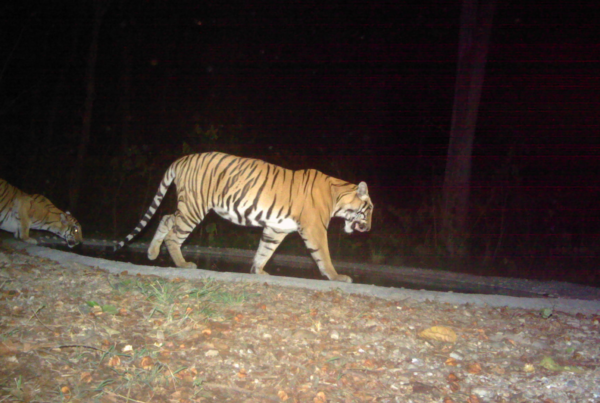
Amur tiger numbers are also monitored and their numbers appear to be mroe stable with 3-4 adulta tigers in the study area in all years except 2010 when two new females arrived. In 2011 the camera traps twice captured a litter of three cubs bringing the total number to 7 tigers. As with the leopards, the presence of cubs and transients indicates reproduction is good and this particular population appears to be sustaining itself.
Vets gather important health information
A team of scientists from Wildlife Conservation Society, Wildlife Vets International and Zoological Society of London, has just completed a two month long field trip in the Russian Far East. Their mission was to gather information on the health of the few remaining Amur leopards, if they were lucky enough to catch any that is! Unfortunately they didn’t see any actual leopards although they did successfully catch two Amur tigers Panthera tigris altaica and two Asiatic black bears Ursus thibetanus. In the photo above, you can see the team examining one of the tigers and taking blood samples before it was safely released again.
Gathering information on the health of the tigers and the bears in this area is essential as they share the habitat with the Amur leopards, hence any diseases found in the tigers and bears could also pose a major risk to the leopards, one that could be particularly disastrous as the wild numbers are already so low. It is also important to know what diseases are being carried by species endemic to the area as in the future there may be a second population of Amur leopards released and knowledge of the challenges they may face will be essential, as well as ensuring they do not bring in new diseases to the fragile wild population.
Despite not seeing any leopards in the flesh, new camera trap images of leopards were obtained including this one which shows a leopard with a very short tail, the first seen like this in the wild. It is possible this was caused by an injury to the tail, or more worryingly it could be a sign of inbreeding.
During the early 20th Century, the Amur tiger was almost driven to extinction. Expanding human settlements, logging and poaching forced the tiger out of 90% of its range. By the 1940s, there were only 20 to 30 Amur tigers in the wild, creating a ‘genetic bottleneck’.
Samples from 15 wild Amur tigers were analysed by a team of Russian, Spanish and German scientists. The aim was to find out how genetically diverse the wild population was and whether the 1940s severe population bottleneck had had a significant effect.
The samples were screened for certain genetic ‘markers’. The ‘markers’ are points in the DNA code which show whether the parents were very related to each other or whether they were genetically different. The evidence from the analysis pointed towards a bottleneck in recent history, the 1940s crisis, had had a severe effect on the variety of genes in the gene pool.
"Our results are the first to demonstrate a quite recent genetic bottleneck in Siberian tigers, a result that matches the well-documented severe demographic decline of the Siberian tiger population in the 1940s," the researchers wrote in the paper.
More than 70 years later, the Amur tiger population has not recovered from this event, however there is still hope. The Zoological Society of London administers a carefully managed breeding programme which ensures that the captive-bred tigers are retaining over 90% of their genetic diversity. This captive population serves as a gene reserve if a tragedy occurs in the wild.

Purchase an Amur leopard print - a percentage of the sales will go to ALTA.
In addition, Amur Leopard Conservation T-Shirts are available from the Feline Conservation Center (FCC).